
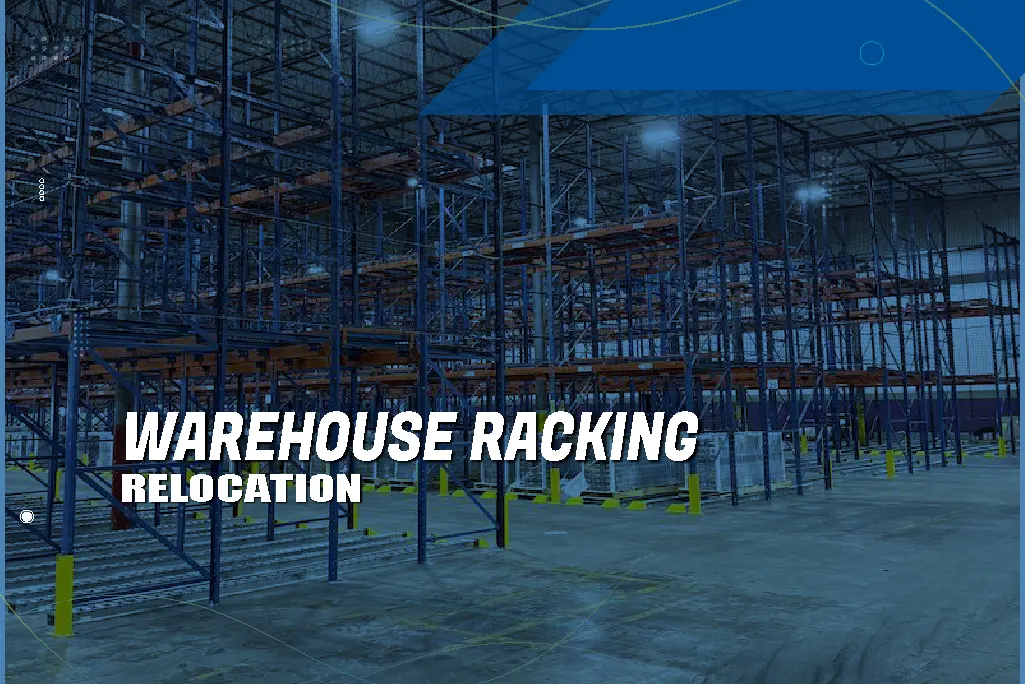
Why moving racking systems is more complex — and risk-sensitive — than most warehouses expect
Warehouse relocation projects often focus on timelines, square footage, and logistics. Equipment is scheduled to move, inventory is planned, and operations prepare for transition. However, racking systems are frequently treated as static assets that can simply be dismantled and reassembled without deeper evaluation.
While relocating racking may appear straightforward, it is a high-risk structural operation. When not properly engineered, supervised, and inspected, relocation can introduce hidden vulnerabilities that compromise safety and long-term operational stability.
Relocating warehouse racking is not just a physical move. It is a structural reset.
The Difference Between Moving Equipment and Relocating Structural Systems
A warehouse rack is not furniture. It is a load-bearing structure designed around specific environmental and operational conditions.
Racking is engineered for a specific environment
Racking systems are originally installed based on:
Floor slab condition and thickness
Anchor specifications
Load configuration
Seismic requirements
Operational traffic flow
When racks are moved to a new facility, those variables change. Floor flatness, slab capacity, and anchoring conditions may differ significantly from the original location.
Relocation without re-evaluation increases structural uncertainty.
Relocation affects load integrity
During disassembly, beams, uprights, anchors, and connectors can suffer hidden stress. Even careful teardown processes introduce wear. Reinstallation without inspection may reintroduce compromised components into active use.
Relocation must include inspection, not just reassembly.
Why Racking Relocation Is a Critical Safety Factor
Warehouse relocations often operate under tight deadlines. In these scenarios, speed becomes the priority. Safety and engineering review can unintentionally become secondary considerations.
This creates risk.
Disassembly exposes structural weaknesses
Damage that was previously unnoticed may become visible during teardown. Bent uprights, weakened connectors, or fatigued beams can compromise load capacity if reused without evaluation.
Ignoring these indicators transfers risk into the new facility.
Reinstallation changes performance conditions
Even identical rack configurations behave differently under new traffic patterns, forklift routes, and operational pressure. What was safe in one facility may require reinforcement, re-anchoring, or redesign in another.
Relocation is an opportunity to correct design limitations — not repeat them.
Operational Risk of Improper Racking Relocation
Most racking failures do not occur immediately after installation. They develop over time due to improper anchoring, misalignment, or structural stress introduced during reassembly.
Misalignment reduces structural stability
Improper leveling or anchoring weakens the system’s ability to distribute load correctly. This increases vulnerability to impact damage and long-term fatigue.
Inconsistent component reassembly
Mixing incompatible components, reusing worn anchors, or overlooking torque specifications creates hidden instability. These issues may pass visual inspection but fail under operational pressure.
The consequences often surface during peak usage — when disruption is most costly.
Safety, Downtime, and Business Impact
Racking relocation mistakes rarely remain isolated technical issues. They affect productivity, safety, and financial performance.
Downtime from preventable structural issues
Improperly installed racks may require shutdowns for corrective action. Emergency adjustments disrupt inventory flow and fulfillment schedules.
Relocation should reduce operational friction — not introduce new instability.
Increased liability exposure
Structural failures following relocation can expose businesses to regulatory penalties, insurance complications, and legal claims. In many cases, the issue traces back to inadequate engineering review during the move.
The cost of professional relocation planning is significantly lower than the cost of reactive correction.
Moving From Simple Relocation to Strategic Reconfiguration
Warehouses that approach relocation strategically use it as an opportunity to improve efficiency and reduce long-term risk.
Engineering review before reinstallation
A professional evaluation should include:
Structural integrity assessment
Component inspection
Anchor and slab compatibility review
Load recalculation
Layout optimization
Relocation is not a copy-paste process. It is a re-engineering process.
Layout optimization during relocation
Relocation provides a unique chance to:
Improve aisle width and flow
Reduce forklift congestion
Increase storage density safely
Integrate safety reinforcement systems
When done properly, relocation strengthens operational performance instead of simply restoring previous conditions.
Building a Safer and More Efficient Warehouse Through Proper Relocation
Warehouse racking relocation is more than dismantling and reinstalling steel structures. It is a structural transition that affects safety, load performance, compliance, and operational continuity.
Treating relocation as a logistical task rather than a structural project increases risk. Approaching it with engineering oversight, inspection protocols, and strategic planning protects people, inventory, and the business itself.
A properly executed relocation ensures that the new facility begins operations with structural integrity, regulatory alignment, and optimized workflow.